

Flutter vs React Native in 2026: When We Recommend Each for B2B Apps
B2B mobile is not a framework beauty contest. In 2026 we choose Flutter or React Native based on team skills, release cadence, offline needs, and how much native surface area you truly require.
Every year someone declares a winner in the Flutter vs React Native debate. In 2026 the honest answer for B2B mobile products is still it depends—but the dependencies are clearer than they were three years ago. Framework marketing focuses on hello-world demos; production B2B apps care about role-based access, offline field workflows, long-lived releases, audit trails, and integrations with SSO and document systems your customer already runs.
At Triaxo we ship both stacks. We do not anchor on a single framework because client constraints differ: an internal ops app for 200 warehouse staff with rugged Android scanners is not the same problem as a sales enablement app that must reuse a React design system from the web portal. This article explains how we recommend Flutter or React Native in 2026 engagements—and where we push teams toward native or a hybrid approach instead.
Executive summary: our 2026 recommendation lens
- Recommend Flutter when you want one UI codebase with predictable rendering, strong custom design systems, desktop/tablet expansion, and a team comfortable with Dart—or willing to invest once for long product life.
- Recommend React Native when your organization already ships React on web, you want maximum hiring pool overlap, you need deep JavaScript ecosystem packages, or you are extending an existing RN app with new B2B modules.
- Pause cross-platform when the product is mostly AR, background GPS, complex Bluetooth peripherals, or OS-level extensions—budget for native modules early or split the app by surface.
What changed by 2026 (and what did not)
React Native's New Architecture is the default path for new apps in most greenfield work we see—Fabric and TurboModules reduced bridge bottlenecks that hurt complex lists and animation-heavy dashboards. Flutter 3.x continues to improve impeller rendering and desktop/web targets, which matters when B2B buyers ask for "one codebase" across phone, tablet, and a lightweight admin shell.
What did not change: B2B apps still spend disproportionate effort on auth (SSO, MFA, device policies), offline sync, PDF and signature flows, role-based navigation, and long-term upgrades. Framework choice affects velocity on those features—but only if your team masters the stack. A mediocre React Native codebase owned by a strong React team beats a Flutter rewrite staffed by reluctant JavaScript generalists.
Maturity signals we look for
- Clear LTS upgrade policy and documented breaking changes.
- Production crash reporting with symbolicated stacks.
- Proven packages for maps, secure storage, biometrics, and document capture.
- CI pipelines that build signed artifacts per environment without manual steps.
When we recommend Flutter for B2B
We steer toward Flutter when UI consistency and custom design systems dominate the roadmap—field service apps, inspection checklists, branded partner portals, and products where marketing cares about pixel-perfect parity across Android and iOS. Flutter's widget model reduces "it looks different on Samsung" surprises that B2B buyers notice in UAT.
Flutter fits especially well when…
- You plan tablet + phone + desktop (Windows/macOS) from one codebase.
- Offline-first sync with structured forms is core—not a phase-two nice-to-have.
- Your team values strongly typed Dart and a single UI language over sharing JSX with web.
- You need predictable performance on mid-range Android devices common in emerging markets.
- Design is bespoke; you are not cloning an existing React component library from the web app.
Flutter tradeoffs to budget upfront
Dart hiring pools are smaller than JavaScript in many regions—plan onboarding or staff augmentation. Heavy platform channels for obscure hardware still require Kotlin/Swift expertise. App size can be larger than lean native apps; acceptable for B2B, less so for consumer viral installs.
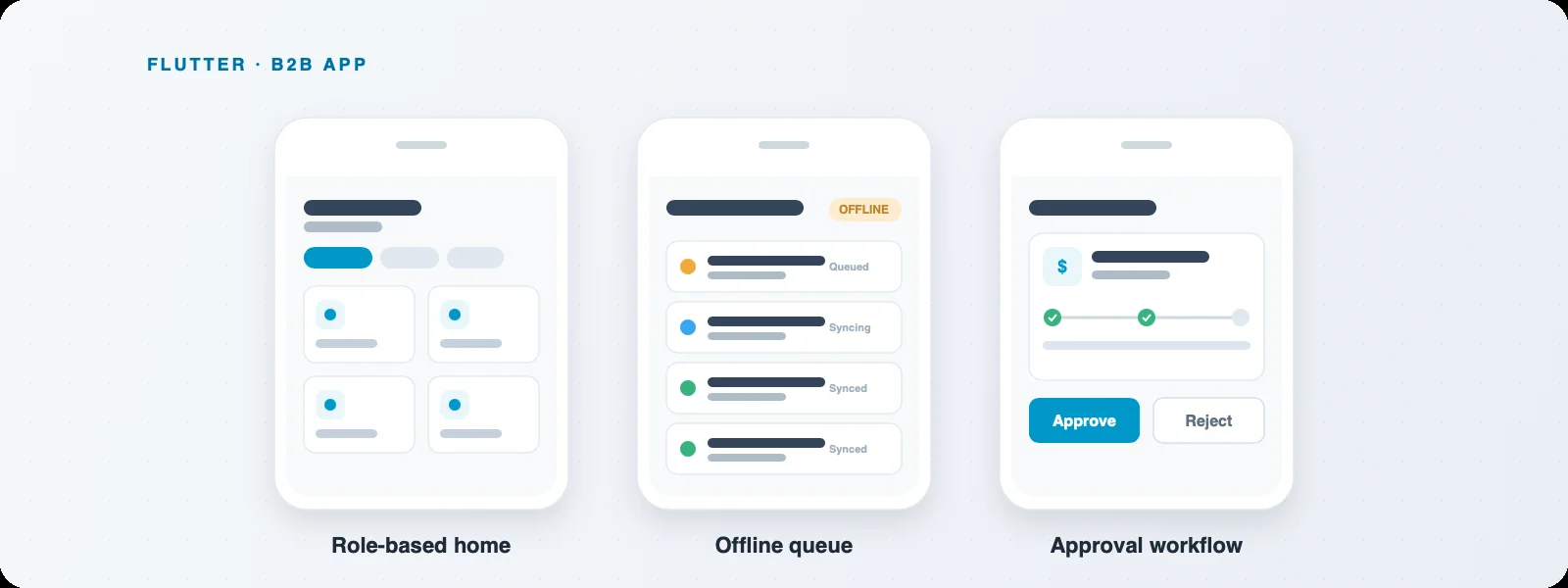
Example B2B mobile UI built with Flutter: role-based home, searchable lists, and approval workflows on iOS and Android from one codebase.
When we recommend React Native for B2B
We steer toward React Native when the organization already ships React on web and wants shared patterns, hooks, and TypeScript models across surfaces. B2B SaaS companies with a customer admin portal in React often accelerate mobile by reusing validation logic, API clients, and design tokens—provided you invest in a proper monorepo or package boundaries, not copy-paste.
React Native fits especially well when…
- Your web team is React-first and mobile is an extension of the same product.
- You rely on npm packages for charts, calendars, rich text, or form builders already proven on web.
- OTA update strategies (CodePush or similar) must ship critical fixes outside store review windows—understanding store policy limits is still required.
- You are incrementally mobile-izing an existing RN codebase rather than rewriting.
- Integration with Expo tooling accelerates dev builds for distributed teams.
React Native tradeoffs to budget upfront
Bridge-adjacent bugs still appear at the edges—especially with third-party native modules that lag New Architecture support. Layout differences across OEM Android skins require QA discipline. Sharing too much UI code with web without abstraction leads to leaky abstractions; share domain code first.
Comparison dimensions that matter in B2B
Security and enterprise mobility
Both frameworks support certificate pinning, secure enclave storage, jailbreak detection, and MDM deployment. B2B buyers increasingly ask for Intune/MAM compatibility and audit logs for sensitive actions. Neither framework removes the need for server-side authorization—mobile RBAC is a complement, not a substitute.
Offline and sync
Field B2B apps (utilities, logistics, healthcare visits) need queued mutations, conflict resolution, and visible sync status. Flutter's isolates and structured widget rebuilds help complex offline UIs; React Native teams often pair WatermelonDB, Realm, or custom SQLite layers. Choose based on who will own sync logic for five years—not demo latency.
Accessibility and compliance
WCAG-minded customers ask about screen reader labels, focus order, and contrast. Both stacks can comply; Flutter requires deliberate Semantics widgets, React Native requires disciplined accessibility props on custom components. Bake accessibility into your UI/UX design system early—retrofits are expensive in B2B because UAT cycles are formal.
Release engineering
B2B apps frequently ship via MDM or private store listings, not only public App Store SEO. Plan environment flavors (dev/stage/prod), feature flags, and crash budgets before MVP launch. Our MVP development engagements include a mobile release checklist even when scope is "just a pilot."
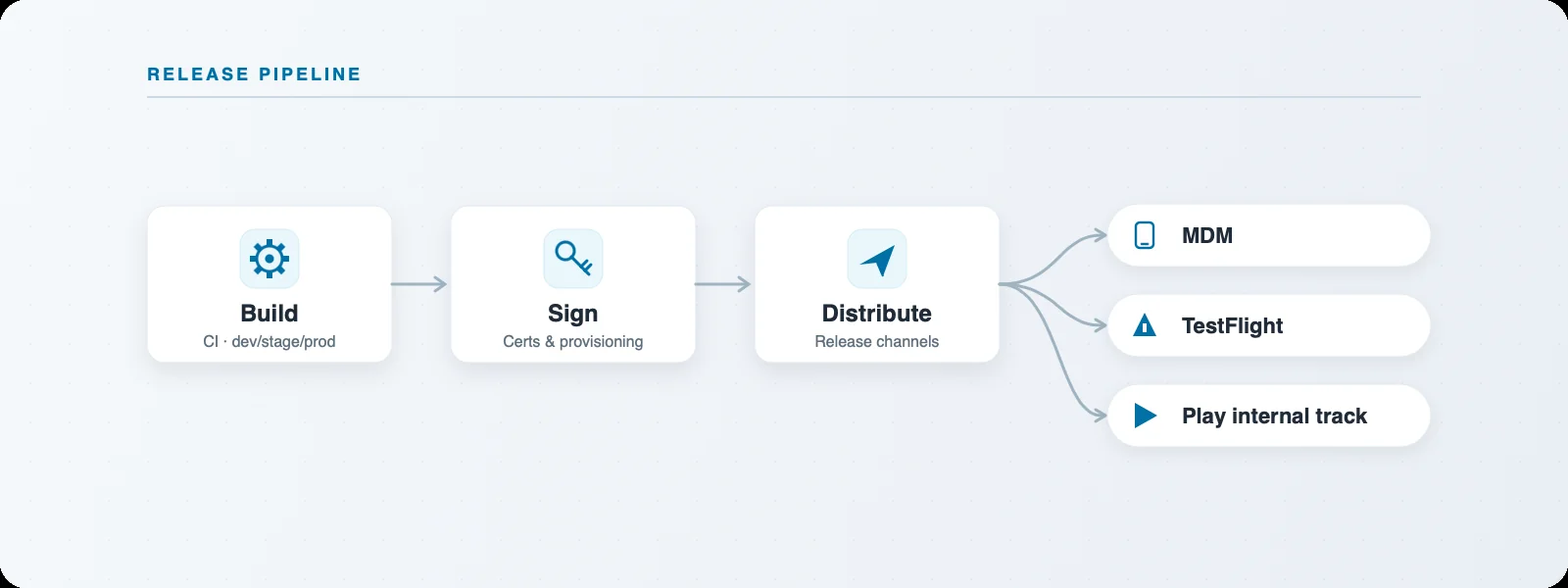
B2B release pipeline: signed builds per environment, automated tests, and distribution through MDM, TestFlight, or Play internal tracks.
Decision framework: questions we ask in discovery
- Team: Who maintains the app in year two—internal React web devs or a dedicated mobile squad?
- Surfaces: Phone only, or tablet/desktop within 12 months?
- Native depth: List every hardware/SDK integration (scanners, BLE, background location, VoIP).
- Design: Custom design system vs reuse web components?
- Integrations: SSO (OIDC/SAML), document viewers, e-sign, push notification policies.
- Lifecycle: Expected major OS upgrades per year and minimum supported OS versions.
- Geography: Emerging-market Android mix vs enterprise iPhone fleets.
Scorecard template
Weight criteria 1–5 by business impact. Flutter typically wins custom UI + multi-surface; React Native wins team overlap + npm ecosystem + incremental extension. If scores are within 10%, pick the stack your team will still enjoy maintaining after the launch party.
When we recommend native or hybrid instead
Some B2B products are mostly a thin shell around OS capabilities—call recording compliance, AR measurement, complex Bluetooth provisioning. We split modules: native SDK wrapper + shared API layer, or companion apps per platform. Cross-platform dogma is expensive when 70% of value is platform-specific.
Real delivery: what good looks like
On consumer-facing products like our Stashy case study, mobile experience tied directly to revenue—performance and polish were not negotiable. B2B can feel less glamorous but the bar is rising: users compare your inspection app to the consumer apps they use at home. Sluggish lists and cryptic errors erode trust with site managers and procurement alike.
Pick the framework your team can operate in production—not the one that won a Twitter poll.
Triaxo Mobile Engineering
How Triaxo can help
We run short discovery workshops that end in a written recommendation (Flutter, React Native, or hybrid), a risk register for native modules, and a phased roadmap aligned to your mobile app development goals. If you are choosing between stacks for a B2B pilot, bring your integration list and team roster—we will be direct about which path saves you a rewrite in 18 months.
Recent Posts