

Azure vs AWS for .NET and SaaS Startups: A Practical Migration Checklist
Azure and AWS both run .NET well in 2026. The right choice for your SaaS startup is usually about identity, managed services your team already knows, data residency, and migration risk—not generic benchmark scores.
If you build on .NET and sell SaaS, you will be asked to pick Azure or AWS—often before you have enough production traffic to learn from real bills. Both clouds are mature for ASP.NET Core APIs, background workers, SQL databases, and containerized services in 2026. The decision that ages badly is choosing based on a conference slide instead of your team's skills, compliance boundaries, and migration path from whatever you run today.
We help startups and scale-ups on cloud infrastructure and DevOps engagements. This note is our practical checklist: when we lean Azure, when we lean AWS, how services map, and how to migrate without a risky big-bang weekend.
Framing the decision for .NET SaaS teams
Treat cloud choice as a multi-year operations commitment, not a hosting invoice. Identity integration (Entra ID vs IAM patterns), observability defaults, secret management, database migration tooling, and regional data residency all compound. A team that has shipped five years on Azure App Service and Azure SQL will move faster there—even if AWS raw EC2 pricing looks cheaper on a calculator.
When we lean Microsoft Azure
Azure is often the default for teams already invested in Microsoft 365, Entra ID (Azure AD), and Visual Studio-centric workflows. .NET on Azure is first-class—not an afterthought.
Azure advantages for .NET SaaS
- Identity: Entra ID, B2B/B2C, and conditional access integrate cleanly with enterprise buyers.
- App Service / Container Apps: fast path for ASP.NET Core APIs with slot swaps and managed certificates.
- Azure SQL / Cosmos: familiar tooling for EF Core teams; geo-replication options for SaaS tenants.
- Azure DevOps & GitHub Actions: pipelines your .NET team may already use.
- Compliance narratives: strong story for healthcare and government buyers on Azure regions and attestations.
Watch-outs on Azure
Cost surprises often come from mis-sized App Service plans, SQL DTU/vCore choices, and unbounded log analytics ingestion. FinOps discipline matters on every cloud.
When we lean Amazon Web Services
AWS wins when you need the broadest service catalog, multi-cloud neutrality narratives, or your team already operates on ECS/EKS, RDS, and IAM patterns learned at scale.
AWS advantages for .NET SaaS
- Mature primitives: EC2, ECS/EKS, Lambda, and RDS are well documented with large community examples.
- Marketplace & partners: buyers and investors often assume AWS fluency.
- Graviton and savings plans: competitive compute pricing when architected for arm64.
- Data services breadth: S3 event pipelines, Kinesis, OpenSearch, and Redshift for analytics-heavy SaaS.
- IAM granularity: powerful—but you must invest in least-privilege design early.
Watch-outs on AWS
.NET is fully supported but some console defaults skew toward Linux containers and Java examples—budget time for .NET-specific base images and AWS SDK versioning. Entra-heavy enterprises may still federate identity, but UX is smoother when cloud and IdP align. The visual below maps common Azure services to AWS equivalents for planning conversations.
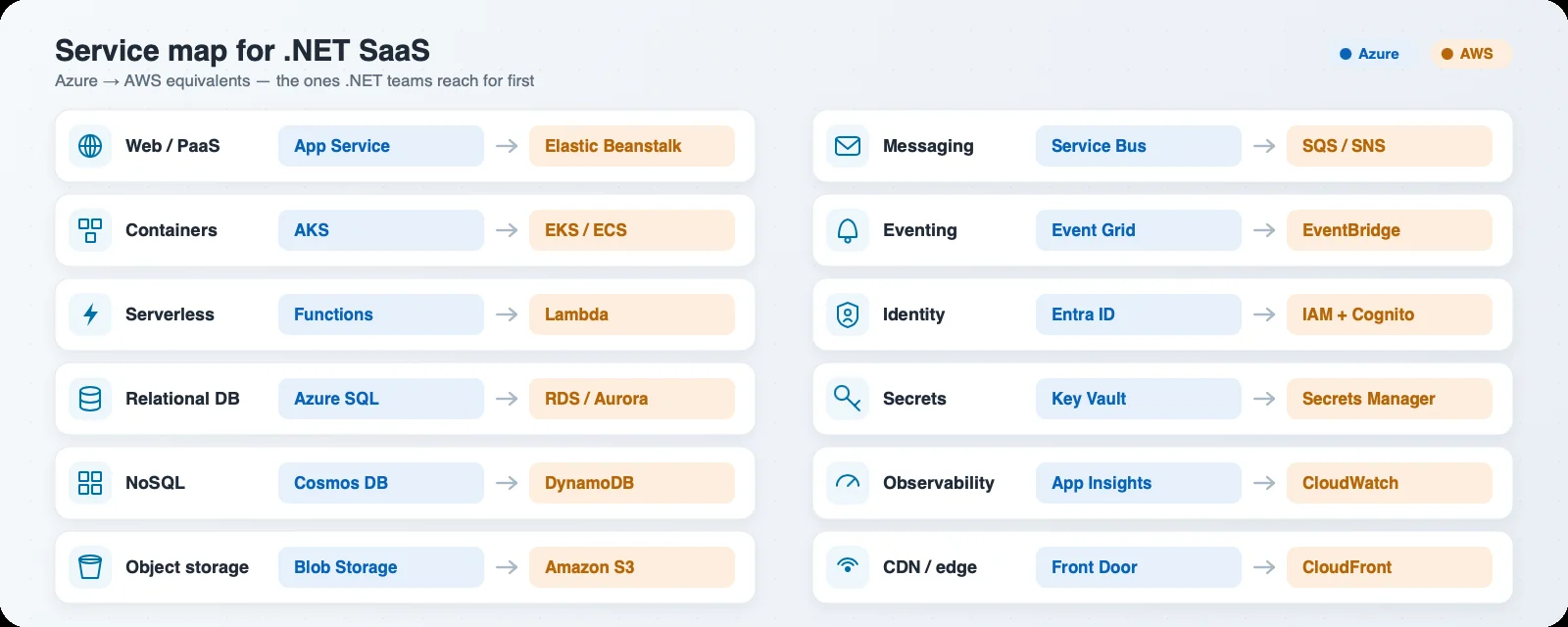
Azure ↔ AWS service equivalents for .NET SaaS teams—use this map when comparing quotes, RFPs, or migration estimates.
Service mapping cheat sheet
Use this when comparing quotes or migration estimates—not every service has a 1:1 twin, but planning conversations need shared vocabulary.
- Compute (PaaS): Azure App Service ↔ AWS Elastic Beanstalk / App Runner.
- Containers: Azure Container Apps / AKS ↔ Amazon ECS / EKS.
- Functions: Azure Functions ↔ AWS Lambda.
- Relational DB: Azure SQL ↔ Amazon RDS (SQL Server or PostgreSQL).
- Object storage: Azure Blob Storage ↔ Amazon S3.
- Secrets: Azure Key Vault ↔ AWS Secrets Manager + KMS.
- CDN / edge: Azure Front Door ↔ Amazon CloudFront.
- Observability: Azure Monitor / App Insights ↔ CloudWatch + X-Ray (often plus Datadog/New Relic).
- Queues: Azure Service Bus ↔ Amazon SQS / SNS.
- Identity: Entra ID ↔ Amazon Cognito (different philosophies—do not assume drop-in).
Practical migration checklist
Whether you move datacenter → cloud or Azure ↔ AWS, sequence risk reduction before optimization.
1. Inventory and classify workloads
- List every environment: prod, staging, demo, per-tenant sandboxes.
- Tag stateful vs stateless services.
- Document RPO/RTO per tier.
- Identify compliance boundaries (PII regions, encryption keys).
2. Identity and access first
Map human access (SSO groups) and machine access (CI/CD roles, workload identity). Broken IAM blocks migration weekends harder than database size.
3. Data migration strategy
- Choose dump/restore vs continuous replication (DMS, native SQL replication).
- Plan cutover window and backward sync if rollback needed.
- Validate charset, collation, and EF migrations on target.
- Load-test connection pooling on the new network path.
4. Application portability
Prefer configuration over cloud-specific SDKs in application code where possible—abstract blob storage, queues, and secrets behind interfaces you control. For SaaS development, this pays off on the second cloud feature request.
5. Networking and DNS
- VPC/VNet design: public subnets for ingress, private for data.
- TLS certificates and HSTS before go-live.
- Lower TTLs pre-cutover; plan rollback DNS.
- WAF rules for OWASP top ten on public APIs.
6. CI/CD and artifacts
Rebuild pipelines to deploy infrastructure as code (Bicep/Terraform/CDK). Immutable artifacts per commit; smoke tests after deploy with automatic rollback hooks—patterns we document in CI/CD before you think you need it.
7. Observability baseline
Stand up logging, metrics, and tracing before migration—not after the first outage. Correlate deploy markers with error rates. See observability baseline for SaaS.
8. FinOps guardrails
- Budget alerts per environment.
- Right-size non-prod; schedule shutdowns.
- Reserved capacity only after 60–90 days of stable usage.
- Tag resources by tenant/feature for unit economics.
9. Security and compliance
- Encrypt data at rest with customer-managed keys if required.
- Enable audit logs for control plane changes.
- Pen-test external attack surface post-migration.
- Document shared responsibility model for sales security questionnaires.
10. Cutover and hypercare
Run game days: failover, restore from backup, revoke compromised credentials. Hypercare week with war room channel and explicit rollback owner.
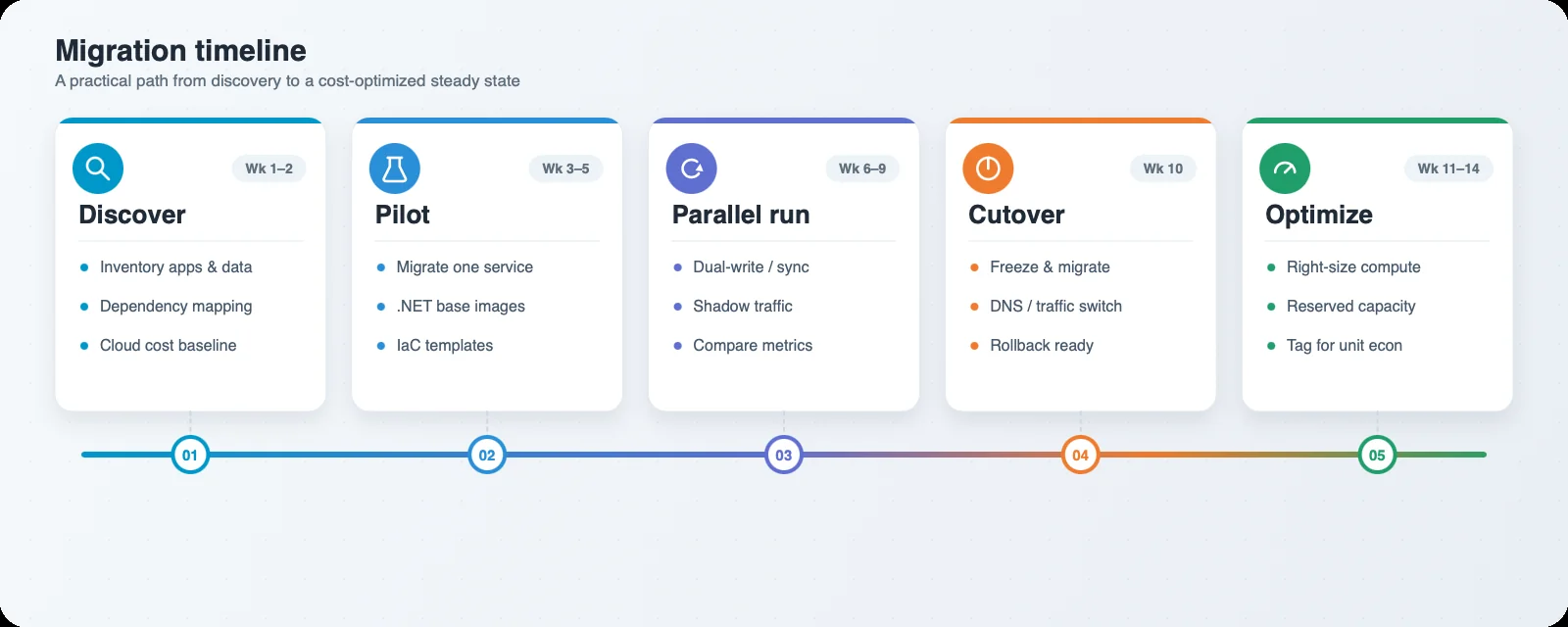
Typical migration waves: inventory and identity first, then data and apps in parallel, cutover with hypercare, and optimize once traffic is stable.
Multi-tenant .NET SaaS on either cloud
Cloud choice does not replace tenant isolation design. Review our note on multi-tenant data isolation before migrating tenant data en masse.
- Pool vs silo databases: cost vs isolation tradeoff.
- Row-level security in PostgreSQL/SQL Server vs separate schemas.
- Key per tenant encryption for regulated clients.
- Noisy neighbor controls: rate limits and per-tenant quotas.
Cost comparison without fantasy math
Calculator outputs assume 24/7 peak utilization and perfect reserved-instance planning. Real startups spike on deploy days and sleep at night. Model three scenarios: lean MVP, expected growth, and "viral week" burst. Include egress, support plans, and third-party observability—not only compute and RDS.
Decision summary
- Choose Azure if Entra-centric identity, Microsoft enterprise sales, and .NET PaaS velocity dominate.
- Choose AWS if your team already runs production on AWS, you need maximum service breadth, or investors/partners standardize on AWS.
- Choose multi-cloud later only with operational maturity—most Series A–B SaaS should not pay that tax early.
Migrate with a checklist, not a slogan. The cloud is an operations model, not a logo on your pitch deck.
Triaxo Cloud Engineering
How we help
We run cloud readiness assessments for .NET SaaS teams: architecture review, migration wave plan, IaC bootstrap, and pipeline hardening. Whether you land on Azure or AWS, the goal is the same—production you can sleep through. Start a conversation via our cloud infrastructure service or bring your current architecture diagram to a scoping call.
Recent Posts