

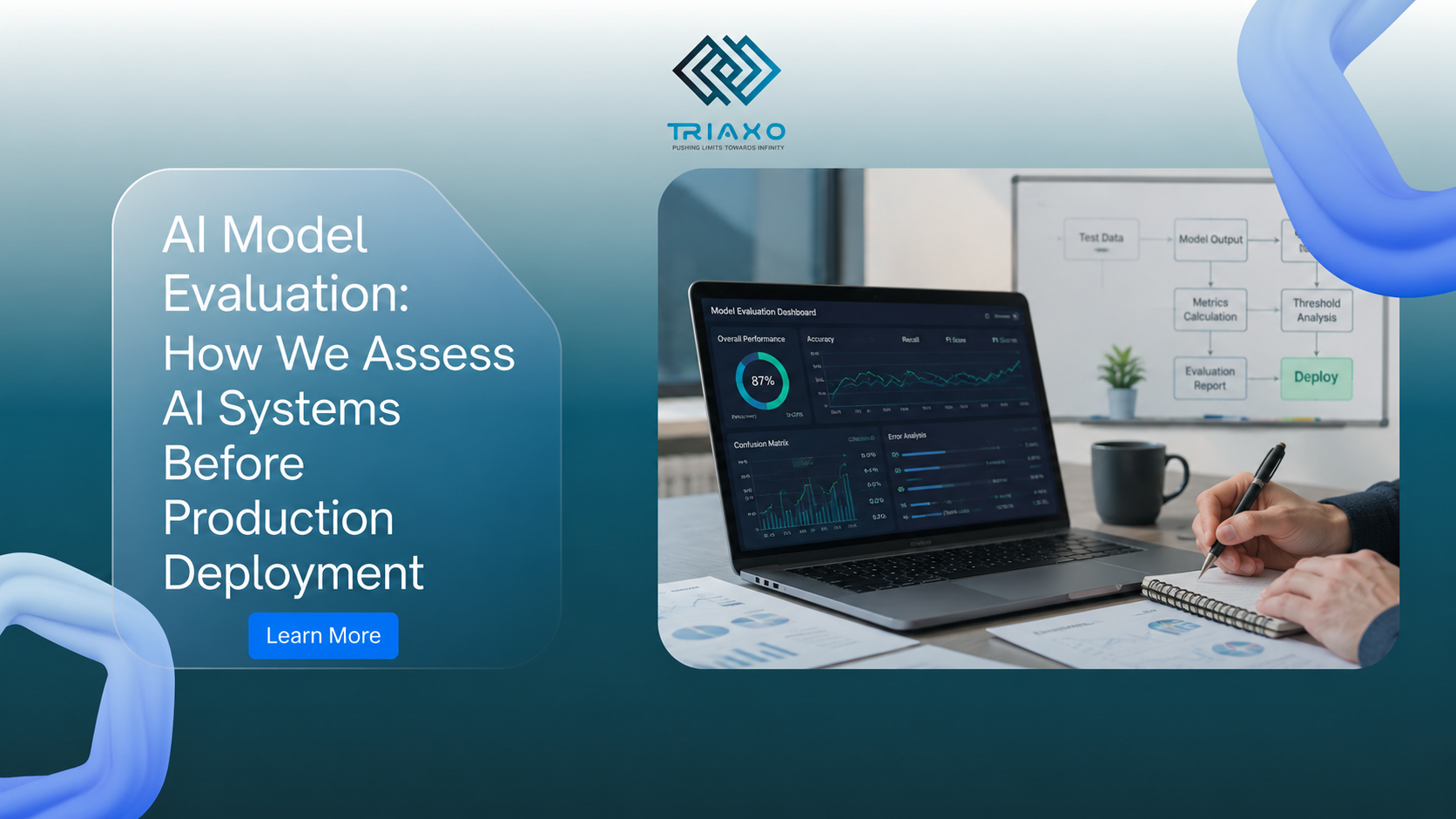
AI Model Evaluation: How We Assess AI Systems Before Production Deployment
Building an AI model is only half the job. Here is the ten-step evaluation framework Triaxo uses to validate performance, security, fairness, and scalability before systems reach production.
Artificial Intelligence (AI) is becoming a practical part of everyday business operations. Whether it is automating repetitive tasks, improving customer support with AI chatbots and agents, analyzing large volumes of data through predictive analytics, or helping teams make faster decisions, AI is creating new opportunities across industries.
But building an AI model is only half the job. The real challenge begins when that model needs to perform in real-world conditions. A system that works well during development can behave very differently once it starts handling live data, customer interactions, or business-critical workflows.
That is why evaluating AI systems before deployment is so important. Without proper testing, businesses can run into issues such as inaccurate results, security vulnerabilities, compliance concerns, and poor user experiences.
At Triaxo Solutions, we help organizations validate and refine their AI and machine learning solutions before they reach production. Our approach focuses on practical performance, reliability, security, and scalability, ensuring that AI systems deliver value when they matter most.
Why AI Model Evaluation Matters
Many organizations invest significant time and resources into developing AI models but pay less attention to how those models perform after deployment.
The reality is that even well-trained machine learning models can produce unexpected outcomes when exposed to new data, changing business conditions, or complex user interactions. For retrieval-augmented and copilot-style systems, we apply a similar discipline to what we describe in our note on production RAG evals before ship—golden scenarios, citation checks, and regression gates tied to real documents.
A thorough evaluation process helps businesses:
- Identify weaknesses before deployment
- Improve accuracy and consistency
- Reduce operational risks
- Strengthen data security
- Meet compliance requirements
- Build confidence among users and stakeholders
- Ensure long-term performance
Simply put, testing early is far less expensive than fixing problems after launch.
Our AI Model Evaluation Framework
1. Business Goal Alignment
Every AI project should have a clear purpose. Before reviewing technical performance, we make sure the solution is addressing a real business challenge and supporting measurable objectives. Technology should support business outcomes, not exist for its own sake.
2. Data Quality and Readiness Assessment
The quality of an AI system depends heavily on the quality of the data behind it. For businesses implementing OCR and Document AI solutions, accurate document extraction and clean datasets are especially important. Small data issues can quickly affect model performance at scale.
We review data quality, consistency, completeness, relevance, and potential sources of bias before moving forward.
3. AI Performance Validation
A model may achieve strong results during development but still struggle in production. Our testing process focuses on how well the system performs under realistic conditions—representative traffic, edge cases, and the same integrations it will use in production—helping ensure that AI solutions continue delivering accurate and dependable results after deployment.
4. Generative AI Testing
Generative AI applications and LLM integrations require a different type of evaluation because outputs can vary depending on prompts, context, and user behavior.
We assess response quality, factual accuracy, consistency, context retention, and overall usefulness to ensure users receive reliable outputs.
5. Bias and Responsible AI Assessment
Trust is essential when deploying AI. We evaluate models for potential bias and fairness concerns, helping organizations identify risks before they impact customers, employees, or business operations.
6. AI Security and Risk Testing
Security considerations should be built into every stage of AI deployment. Our assessments focus on areas such as prompt injection risks, data exposure, access controls, API security, and overall system resilience—especially for customer-facing assistants connected to internal tools.
7. Scalability and Load Testing
An AI solution may work perfectly for a small group of users but encounter challenges as adoption grows. Organizations implementing AI automation solutions often need to ensure their systems can handle increasing workloads without affecting performance or reliability. We pair application-level load tests with DevOps and platform readiness so scaling does not become a launch-week surprise.
8. AI Governance and Compliance Evaluation
As AI regulations continue to evolve, businesses need clear governance processes in place. We help organizations evaluate transparency, documentation, risk management practices, and compliance requirements to support responsible AI adoption.
9. User Acceptance Testing
Ultimately, the people using the system determine whether it succeeds. User acceptance testing allows stakeholders to evaluate how well the AI solution fits into existing workflows and whether it delivers meaningful value in day-to-day operations.
10. Continuous Monitoring and Improvement
AI evaluation does not stop after deployment. Models should be monitored regularly to identify performance changes, emerging risks, and opportunities for improvement. Ongoing monitoring helps maintain reliability as business needs and data evolve.
Ship narrow, measure constantly, and expand only when evals stay green—not when the demo looked good in a slide deck.
Triaxo AI Engineering
Why Businesses Partner with Triaxo Solutions
Deploying AI successfully requires more than technical expertise. It requires understanding how AI systems interact with real business processes, users, and operational requirements.
At Triaxo Solutions, we work closely with organizations to evaluate, optimize, and deploy AI systems that are practical, secure, and built for long-term success. Our experience spans:
- AI and Machine Learning Solutions
- Generative AI Applications
- AI Model Evaluation and Testing
- AI Security Assessments
- Enterprise AI Deployment
- AI Automation Solutions
- OCR and Document AI Services
- OpenAI / LLM Integrations
Conclusion
AI can create significant business value, but only when it performs reliably in real-world environments.
Taking the time to evaluate an AI system before deployment helps reduce risk, improve accuracy, strengthen security, and increase user confidence. It also provides a clearer understanding of how the technology will perform once it becomes part of everyday operations.
At Triaxo Solutions, we help organizations move beyond experimentation and deploy AI solutions with confidence. Through careful testing, validation, and ongoing optimization, businesses can build AI systems that deliver measurable results today while remaining adaptable for the future.
Recent Posts